The trend matters more than the reading. The two most productive states are a steady high (roughly 1020 to 1030 hPa, or 30.10 to 30.40 inHg) and the falling hours in front of an approaching low. The hardest fishing is usually the sharp rise straight after a front clears, not the low pressure itself.
Every fishing app shows you a pressure number. Very few tell you what to do with it, and the folklore that fills the gap is a mess of half-remembered rules that contradict each other. So here is the mechanism, the numbers, and the part most articles skip: the honest size of the effect.
What a barometer is actually measuring
Atmospheric pressure is the weight of the air column above you. At sea level the long-run average is 1013.25 hPa, which is the same thing as 29.92 inHg or 1013.25 millibars. Those are three units for one quantity, and the conversion is fixed:
- 1 inHg = 33.86 hPa
- 1 hPa = 1 millibar exactly
Weather systems move that number around by roughly 20 hPa either side of average in normal conditions. A deep Atlantic low might pull it to 975 hPa. A strong continental high might push it past 1035 hPa.
The four states, and what to do in each
Pressure is only interesting as a direction of travel. Read the last six to twelve hours, not the current digit.
| State | Typical reading | What is happening | What to do |
|---|---|---|---|
| Falling | Dropping 2 hPa or more in 3 hours | Weather front approaching, cloud building, wind rising | Fish it. This is the classic pre-front window |
| Low and steady | Below 1005 hPa, flat | The front has arrived and parked. Overcast, often wet | Workable. Fish hold shallower under low light |
| Rising sharply | Up 3 hPa or more in 3 hours | The front has cleared. Cold air, clear sky, hard sun | The hard one. Slow down, go deeper, downsize |
| High and steady | 1020 to 1030 hPa, flat for a day or more | Settled, stable weather | Reliable. Fish have adjusted and resumed a normal routine |
The falling window is the one worth planning around. It is short, often six to eighteen hours, and it stacks several things at once: dropping light, rising wind, a shift in surface temperature. Any of those on its own moves fish.
What pressure does to a fish, physically
Here is the part that gets overstated everywhere, and it is worth being precise about because it changes how much weight you give the number.
A fish controls its depth with a swim bladder, a gas-filled sac that has to be re-equalised whenever ambient pressure changes. Species differ in how fast they can do that:
- Physostomous fish (trout, pike, carp, salmon, herring) keep an open duct between the bladder and the gut. They can gulp or vent gas at the surface and re-trim in seconds.
- Physoclistous fish (bass, perch, walleye, most marine species) have a closed bladder and must move gas through a specialized network of blood vessels. That takes hours.
So the closed-bladder species genuinely have a slower response, and that is the real basis for the folklore.
Now the size of it. Water is about 800 times denser than air, so 1 hPa of atmospheric pressure change is equivalent to about 1 centimetre of water depth. A dramatic 30 hPa swing across a whole weather system is the same pressure change a fish creates by swimming down 30 centimetres. Fish move further than that chasing a single baitfish.
Which tells you something important: the pressure reading itself is a weak direct cause. What makes it useful is that it is an excellent proxy for everything arriving with it. Falling pressure means cloud, wind, chop, a drop in light and often a change in water temperature. Those are the things fish respond to, and pressure is the single number that announces all of them several hours early.
That is why a good forecast treats pressure as one input among several rather than the headline, and why "the barometer is at 1018 so it will be great" is not a prediction.
Depth changes the story
The deeper a fish already is, the smaller the proportional effect of any weather change. At 10 meters a fish is sitting under about 2 atmospheres. A 20 hPa front is roughly 1 per cent of that. At 50 centimetres in a shallow bay, that same front is a much larger share of the total.
The practical version: shallow, weedy, small waters react fastest to pressure changes. Deep lakes and open coast react slowest. If you fish a 2 meter farm pond, the barometer is worth watching. If you fish 40 meters of open water, look at wind and surface temperature instead.
Reading the trend without an app
If you want to do this off a standard weather site:
- Look at the pressure now and six hours ago. The difference is the trend.
- A change of 1 hPa or less over three hours is effectively steady.
- A change of 2 to 3 hPa over three hours is a real move.
- More than 3 hPa in three hours is a front going through. Expect wind.
Set-and-forget version: fish the twelve hours before the rain arrives, and give the water a day after the sky goes hard blue and cold.
Common questions
What is the best barometric pressure for fishing?
A steady high of roughly 1020 to 1030 hPa (30.10 to 30.40 inHg) gives the most consistent fishing, because conditions are stable and fish are on a settled routine. The single most productive short window is usually falling pressure ahead of an approaching front, when the reading drops 2 hPa or more in three hours.
Do fish stop biting when the pressure drops?
No. Falling pressure is generally associated with better feeding, not worse. The difficult period is the sharp rise immediately after a cold front clears, when high pressure arrives with cold air and bright sun. That is the origin of the confusion: people notice the poor fishing after a front and blame the low pressure that preceded it.
How long after a cold front do fish start biting again?
Usually somewhere between 24 and 72 hours, depending on how much the water temperature moved and how deep the water is. Shallow waters recover fastest once the sun has had a day to put warmth back in. See fishing after a cold front for what to change in the meantime.
Does barometric pressure affect saltwater fishing as much?
Less, in general. Open coast and deeper marine water buffer the change, and tide is a far stronger driver of when fish feed inshore. On saltwater the pressure trend is most useful as an early warning of the wind and swell that come with it.
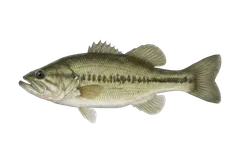 Largemouth bass
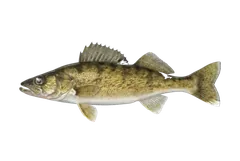 Walleye
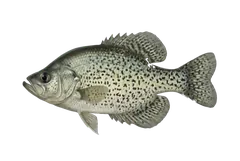 Crappie
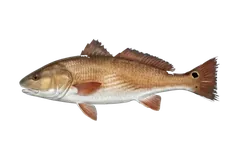 Redfish