
Water Temperature by Species: A Fishing Temperature Chart
Peak feeding temperatures and comfortable ranges for 30 freshwater and saltwater species, in Celsius and Fahrenheit, plus why the trend of the last few days matters as much as today's reading.
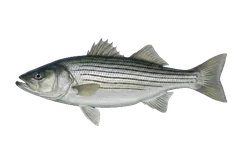
Fish are ectotherms, so water temperature sets the ceiling on how fast they can digest and therefore how often they need to eat. Most species feed hardest within roughly 6°C (11°F) either side of a species-specific optimum: about 27°C (81°F) for largemouth bass, 21°C (70°F) for walleye and smallmouth, 15°C (59°F) for rainbow trout and 18°C (64°F) for striped bass.
Water temperature is the input that moves a fishing forecast more than any other, and it is the one most anglers guess at. This is the chart, followed by the two things that make it useful: reading the trend rather than the number, and knowing where in the water column that temperature actually applies.
Why temperature dominates
A fish cannot regulate its own body temperature. Its metabolic rate is set by the water it is sitting in, and metabolic rate determines how quickly it digests a meal and therefore how soon it needs the next one.
Roughly speaking, metabolism rises with temperature until it hits a species-specific ceiling, then falls away fast as oxygen demand outruns what warm water can hold. Warm water holds less dissolved oxygen, so the top end of the range punishes a fish twice.
That gives every species a bell curve rather than a threshold. Feeding is best near the peak, tapers either side, and shuts down well before the lethal limits at both ends.
Freshwater
The tables below cover the most-fished species. The full water temperature chart for all 350 species is sortable and searchable, and each major species has its own guide with baits and seasonal patterns.
Peak is the temperature at which feeding activity is highest. The band is the range within which a fish will still feed readily.
| Species | Peak | Band |
|---|---|---|
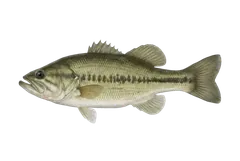
| Largemouth bass | 27°C / 81°F | 21 to 33°C / 70 to 91°F |
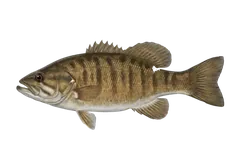
| Smallmouth bass | 21°C / 70°F | 15 to 27°C / 59 to 81°F |
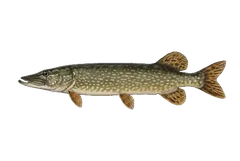
| Northern pike | 19°C / 66°F | 13 to 25°C / 55 to 77°F |
| Muskellunge | 22°C / 72°F | 16 to 27°C / 61 to 81°F |
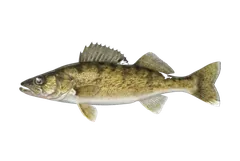
| Walleye | 21°C / 70°F | 14 to 28°C / 57 to 82°F |
| Zander | 24°C / 75°F | 18 to 30°C / 64 to 86°F |
| European perch | 22°C / 72°F | 16 to 27°C / 61 to 81°F |
| Yellow perch | 21°C / 70°F | 15 to 26°C / 59 to 79°F |
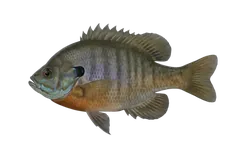
| Bluegill | 28°C / 82°F | 22 to 34°C / 72 to 93°F |
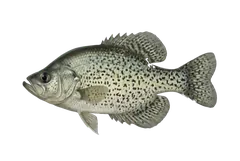
| Black crappie | 21°C / 70°F | 15 to 26°C / 59 to 79°F |
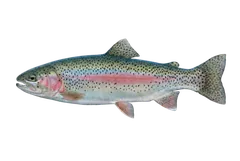
| Rainbow trout | 15°C / 59°F | 10 to 20°C / 50 to 68°F |
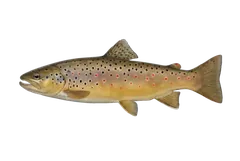
| Brown trout | 16°C / 61°F | 11 to 21°C / 52 to 70°F |
| Brook trout | 14°C / 57°F | 8 to 18°C / 46 to 64°F |
| Grayling | 14°C / 57°F | 8 to 18°C / 46 to 64°F |
| Atlantic salmon | 17°C / 63°F | 11 to 22°C / 52 to 72°F |
| Common carp | 24°C / 75°F | 18 to 30°C / 64 to 86°F |
| Tench | 24°C / 75°F | 18 to 30°C / 64 to 86°F |
| Roach | 24°C / 75°F | 18 to 30°C / 64 to 86°F |
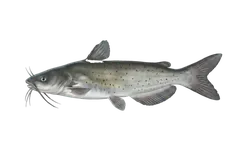
| Channel catfish | 28°C / 82°F | 22 to 34°C / 72 to 93°F |
| Wels catfish | 26°C / 79°F | 20 to 32°C / 68 to 90°F |
| Alligator gar | 26°C / 79°F | 19 to 32°C / 66 to 90°F |
Saltwater
For saltwater species the relevant figure is sea surface temperature, which is what marine forecasts publish.
| Species | Peak | Band |
|---|---|---|
| Striped bass | 18°C / 64°F | 12 to 23°C / 54 to 73°F |
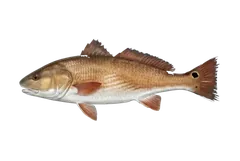
| Red drum | 24°C / 75°F | 18 to 31°C / 64 to 88°F |
| Common snook | 27°C / 81°F | 23 to 33°C / 73 to 91°F |
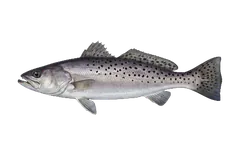
| Spotted seatrout | 24°C / 75°F | 20 to 30°C / 68 to 86°F |
| European sea bass | 26°C / 79°F | 20 to 32°C / 68 to 90°F |
| Gilthead seabream | 25°C / 77°F | 20 to 31°C / 68 to 88°F |
| Sheepshead | 26°C / 79°F | 21 to 32°C / 70 to 90°F |
| Barramundi | 30°C / 86°F | 26 to 35°C / 79 to 95°F |
| Dusky flathead | 21°C / 70°F | 15 to 27°C / 59 to 81°F |
| Yellowfin bream | 22°C / 72°F | 16 to 28°C / 61 to 82°F |
| Atlantic mackerel | 11°C / 52°F | 6 to 16°C / 43 to 61°F |
Note how narrow the cold-water species are. A brook trout has about a 10°C working range. A largemouth has 12°C and tolerates the warm end far better. That difference is why a hot August week can shut down a trout river while the bass lake two valleys over has its best two weeks of the year.
The trend beats the reading
Fish respond to change faster than they respond to level. A lake sitting at 12°C after three weeks at 12°C fishes very differently from a lake at 12°C that was at 18°C on Sunday.
Two rules that hold up:
- A rising trend in spring is the strongest single signal in the calendar. Three or four consecutive days of warming in early season will switch a water on, even if the absolute temperature is still below the species optimum. Fish are coming off a winter metabolic floor and every degree buys them a lot.
- A sharp fall shuts things down out of proportion to its size. A 3°C drop over 24 hours after a cold front does more damage than the same 3°C spread over two weeks. There is no time to adjust.
This is why a good water temperature figure is not the current surface reading but a smoothed value that carries the last few days with it. Large bodies of water have enormous thermal inertia; a small pond can move 5°C in an afternoon and a deep lake will not move 5°C in a month.
Surface temperature is not the temperature where the fish is
Published water temperature is a surface figure. In summer a stratified lake can be 26°C on top and 12°C at 8 meters, separated by a thermocline only a meter or two thick.
What that means in practice:
- In spring and autumn the water column is close to uniform, so the surface reading describes the whole lake and is a good guide.
- In midsummer a warm-water species will often sit just above the thermocline, and a cold-water species below it. The surface number then tells you where the fish is not.
- In rivers, mixing keeps things fairly uniform, so surface temperature is reliable year-round.
- In shallow water, the daily swing is the thing. A 1.5 meter bay can gain 4°C by mid-afternoon and lose it overnight. That daily cycle often matters more than the weekly average.
Using it
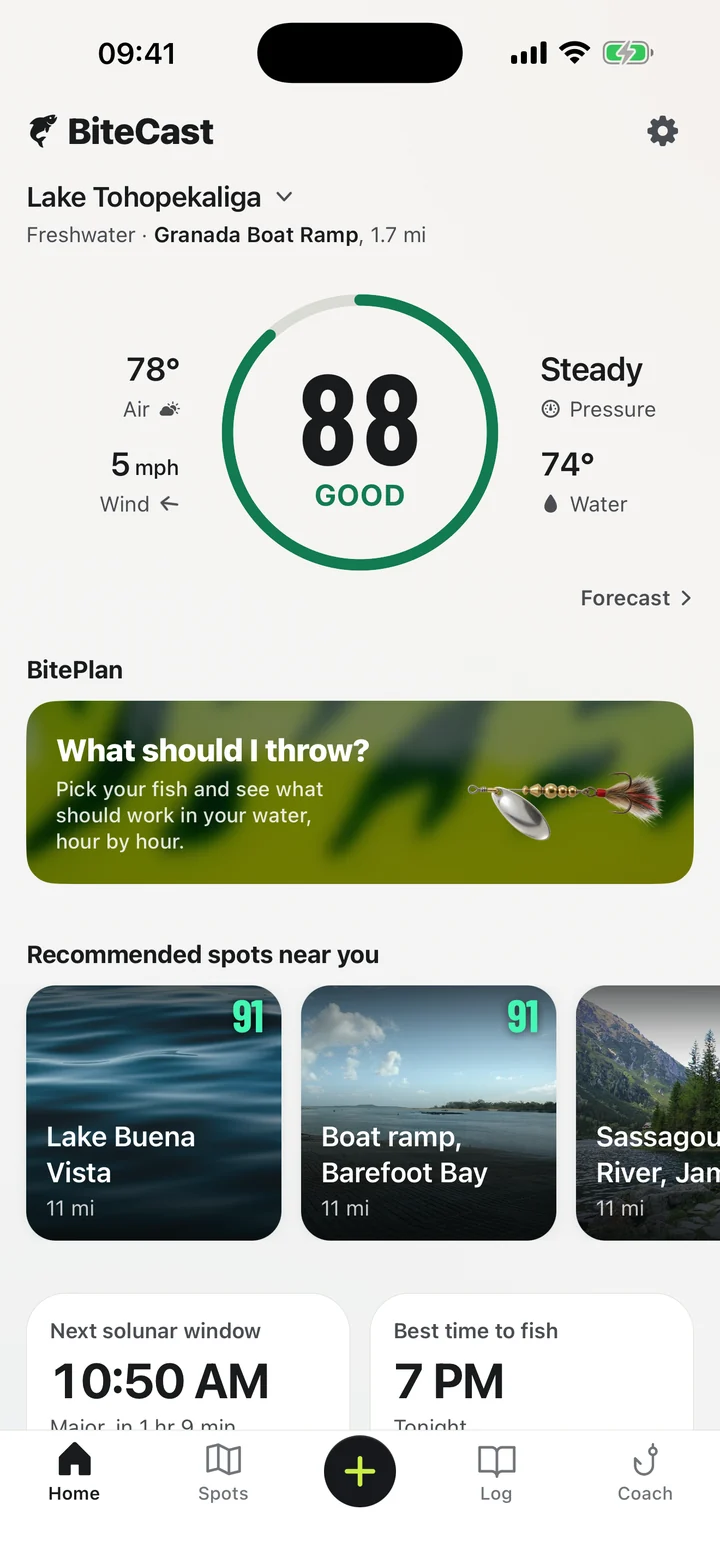
Compare today's water temperature to the species peak and ask three questions. How far off the peak am I? Which direction has it moved in the last three days? And is the water stratified, in which case the fish may be under the number I am reading?
That is the whole method. It is also most of what a fishing forecast is doing when it produces a score.
Common questions
What water temperature do bass start biting?
Largemouth bass begin feeding actively from around 13 to 15°C (55 to 59°F) and get progressively better up to their peak near 27°C (81°F). Below about 10°C (50°F) they still feed but slowly, and presentations need to slow with them. Smallmouth peak considerably cooler, around 21°C (70°F).
What is too hot for trout?
Trout come under real stress above about 20°C (68°F) for rainbows and browns, and above roughly 18°C (64°F) for brook trout. Warm water holds less dissolved oxygen, so a fish hooked and released in water above those figures has a much lower chance of surviving. Many fisheries adopt a "hoot owl" rule and close afternoon fishing when rivers cross that line.
How do I measure water temperature without a boat?
A cheap digital probe thermometer on a lanyard, dropped a foot under the surface at the bank, is accurate enough. For anything beyond a spot check, use a marine or lake forecast: those figures come from models validated against buoy data and give you the trend, which is what actually matters.
Does surface water temperature match the temperature at depth?
Only outside summer. From late spring to early autumn most lakes stratify into a warm upper layer and a cold lower layer with a sharp thermocline between them. Rivers mix continuously and stay close to uniform.