A fishing forecast combines weather, water and astronomy data with a model of how a given species responds to each, and returns a single number. It is a ranking tool, not a probability. It is good at telling you which of Tuesday and Thursday is worth taking off work, and it cannot tell you that you will catch a fish.
Every fishing app now shows a score. Some of them are modelling something. Some of them are a solunar table with a coat of paint. The difference matters, and you can tell them apart in about a minute once you know what to look at.
What goes into the number
A forecast that is doing real work is combining several classes of input.
Weather. Air temperature, barometric pressure and its trend, wind speed and direction, cloud cover, precipitation, and solar radiation. These come from numerical weather prediction models run by national meteorological agencies, the same source your phone's weather app uses.
Water. In freshwater, an estimate of water temperature, which is not the same as air temperature and lags it substantially. In saltwater, sea surface temperature, wave height and period, and tidal height. The lag is the interesting part: a lake carries days of thermal history, so any water temperature figure worth having is a smoothed value rather than today's air temperature with a fudge factor.
Astronomy. Sun elevation through the day, the four twilight boundaries, sunrise and sunset, moon phase and illumination, moonrise and moonset. This is pure calculation and is the one part of a fishing forecast that is exact.
Species. The part that separates a real model from a generic one. A largemouth bass peaks near 27 C and a brook trout is stressed above 18 C. A walleye feeds hardest in twilight and a channel catfish feeds at night. A forecast that returns the same number for both is not forecasting fishing, it is forecasting weather.
Place. Whether the water is fresh or salt, how big it is, how deep, whether it flows. A 2 meter pond and a 40 meter reservoir respond to the same cold front very differently.
Why two apps disagree about the same lake
Three reasons, in order of how much they matter.
Different questions. One app may be scoring "how good is this water for the species you told us you want", another "how good is this water for the fish that actually live in it". Those produce different numbers legitimately, and neither is wrong. Ask which question the number answers before comparing.
Different species assumptions. If the app does not know what lives in your water, it has to assume. Assume largemouth bass in a Scottish loch and you get a number that describes a fish that is not there.
Different weights. Every model decides how much water temperature matters relative to wind. Those choices are judgement calls informed by research, and reasonable people land in different places.
What a score can and cannot do
The honest framing is that a fishing score is ordinal. It ranks conditions against each other. It is not a calibrated probability, and a 70 does not mean a 70 per cent chance of anything.
That still leaves it genuinely useful, because ranking is the decision most anglers are actually making:
- Which of the next eight days is worth taking off work.
- Which two hours of tomorrow to be on the water for.
- Which of four marks within driving distance to try first.
- Whether tonight is worth going at all.
What it cannot do is account for the things that no dataset contains: whether the water turned over last week, whether someone dumped silt upstream, whether the fish have just spawned, whether a match was held there on Saturday, or whether you are fishing the wrong end of the lake. A forecast describes conditions. It does not know the water and it does not know you.
How to tell a real model from a moon table
Four tests, all quick.
Does the number change through the day, and does it change in a shape that makes sense? A model with a proper daily activity term will show peaks at dawn and dusk for most species, a midday dip, and a night trough. If the hourly line is flat or only wobbles at the solunar periods, there is not much behind it.
Does it change if you change the species? Switch from bass to trout on the same water on the same day. If the number does not move, the species is decoration.
Does it tell you why? A model that computes factors can name them. If all you get is a number and a moon icon, there is nothing to interrogate.
Do identical conditions give an identical number? Some apps add random variation so the score looks alive. That makes it useless for comparing two days, because you cannot tell a real difference from noise.
What we do
BiteCast scores every hour for the next eight days, for a specific species in a specific piece of water, from weather and astronomy data plus a species model that carries a temperature optimum, a light preference and a daily activity rhythm for each of 300 species. Salt water gets a separate model built around tide, sea surface temperature and wave state, because the drivers are genuinely different.
The number is deterministic. The same inputs always produce the same output, there is no random variation, and today's score comes with the factors that produced it in plain language, so you can disagree with it. Solunar major and minor periods are shown because anglers expect them, and they are deliberately not allowed to move the score, for the reasons in moon phase and solunar tables.
Used as a ranking tool it will save you a lot of wasted mornings. The full breakdown is on how the Fish Score works, and the fishing forecast apps comparison shows what other apps build their forecasts from.
Common questions
Are fishing forecasts accurate?
A good fishing forecast is accurate about conditions: it will correctly tell you that Thursday looks better than Tuesday on your water, and which hours of Thursday are best. Treat the number as a comparison between days and hours; where you fish and what you throw still decide the catch.
What is a fish score?
A single 0 to 100 value summarizing how favorable current or forecast conditions are for a species in a particular place, computed from weather, water and astronomy data. Higher means conditions line up better with what that species prefers.
How accurate are fishing apps?
Fishing apps are as accurate as the inputs they use. Apps that score water temperature, pressure trend, wind, light and tide for your species rank days and hours well; apps built on the moon alone mostly track tide and twilight. Pick one that shows you why it rates a day the way it does, so you can check it against your own water.
Can you actually predict when fish will bite?
You can predict conditions accurately, and conditions shift the odds. Feeding behavior also depends on things no forecast can see, including recent spawning, local fishing pressure, water clarity after rain and the abundance of natural food. So you can predict good windows, not outcomes.
What data do fishing forecast apps use?
Numerical weather prediction data for air temperature, pressure, wind, cloud and precipitation; marine models for sea surface temperature, waves and tide; astronomical calculation for sun and moon position; and a species model describing temperature preference, light preference and daily activity pattern. The species layer is the part that varies most between apps.
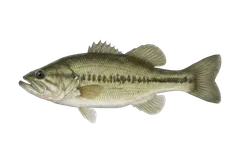 Largemouth bass
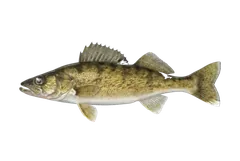 Walleye
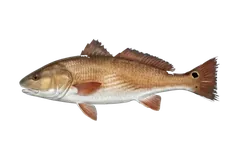 Redfish