Match color to how much light reaches the fish. In clear water use natural, translucent patterns that imitate real prey. In stained water use higher-contrast versions of natural colors, chartreuse, or gold. In muddy water stop thinking about color and think about silhouette and vibration: black, dark blue and solid chartreuse read as a shape when nothing else does.
Tackle shops sell color, and anglers buy a lot of it. Most of the choosing is superstition, but there is a real system underneath, and it comes out of two facts: water removes colors from sunlight in a fixed order, and suspended particles destroy color long before they destroy contrast.
Water eats color in a fixed order
Sunlight arriving at the surface contains the whole visible spectrum. Water absorbs the long wavelengths first, so colors drop out from the red end as you go deeper. In clear water, roughly:
| Color | Roughly gone by |
|---|---|
| Red | 4 to 5 m (15 ft) |
| Orange | 7 to 8 m (25 ft) |
| Yellow | 15 m (50 ft) |
| Green | 25 m (80 ft) |
| Blue | Deepest, last to go |
A red lure at 10 m is not red. It is a dark gray shape. This is why divers see blood as green at depth, and it is the single most quoted underwater-light fact in fishing.
It is also the most misapplied one. Those depths are for clear water. In stained or colored water everything shortens dramatically, and in genuinely dirty water red is gone in under a meter. And it does not mean red is useless deep: a red lure at depth still works as a dark high-contrast silhouette, it just is not working as red.
Turbidity matters more than depth
Most fishing happens in the top few meters, so for most anglers the bigger variable is not depth but suspended particulate: silt, algae, plankton, tannin.
Turbidity does two things. It scatters light, which kills contrast and color saturation, and it shifts the surviving light towards the yellow-green part of the spectrum, because that is what penetrates a particle-laden column best.
That is the mechanism behind chartreuse. It sits right in the band that survives longest in stained fresh water, so it stays visible when everything else has gone gray. It is not magic and it is not universal, but in green or algae-stained water it is doing something real.
The three-bucket system
Rather than trying to think in meters, sort water into three buckets by how far you can see into it.
Clear: more than about 1.5 m of visibility. The fish can see detail, including the parts of your lure that do not look like food. Go natural and translucent. Match the actual forage: shad, perch, crayfish, whatever lives there. Ghost and translucent patterns, subtle flake, realistic profiles. Lighter line, longer casts. This is the water where color choice genuinely rewards care.
Stained: roughly 0.3 to 1.5 m. The most common condition on most waters. Detail is partly lost but contrast still works. Use bolder versions of natural colors, chartreuse, gold, firetiger, white. A gold blade outperforms a silver one here because gold reflects the yellow-red end that silver scatters away.
Muddy: less than about 0.3 m. Color is largely irrelevant and you are working with silhouette and vibration. Black, dark blue and junebug read as the strongest shapes against what little light comes down from above. Solid chartreuse works as a bright block rather than a color. More importantly, switch to something that pushes water: a Colorado blade, a bigger profile, a rattle. A fish that cannot see your lure can feel it through its lateral line from several body lengths away.
The counterintuitive part of that last bucket, and it is worth stating plainly: dark colors often outfish bright ones in dirty water. A fish looking up sees your lure against the lit surface, and black gives the hardest silhouette. Bright colors work by being a solid block, not by being bright.
Light level shifts the whole system
Clarity is only half of it. The same water is a different problem at 6am and at noon.
- Bright sun, clear water: the most demanding combination. Most natural, most translucent, most subtle.
- Overcast, clear water: effectively behaves one bucket dirtier. You can get away with more contrast.
- Dawn, dusk and night: treat as muddy regardless of clarity. Silhouette and vibration. Black is the classic night color for exactly this reason.
- Bright sun, dirty water: the one case where a bright chartreuse or firetiger genuinely shines, because there is enough light entering for it to reflect.
What actually decides it
Color is real but it is far down the list. In rough order of what changes your day:
- Being somewhere with fish in it.
- Fishing at a time they feed.
- Depth and retrieve speed.
- Profile and action.
- Color.
The reason to have a color system at all is not that color is decisive. It is that having a rule stops you burning the good hour of light changing lures every ten minutes.
The short version
- Clear water: natural and translucent.
- Stained water: chartreuse, gold, white, bold naturals.
- Muddy water: black, dark blue, solid chartreuse, and something that vibrates.
- Low light of any kind: treat it as muddy.
- If in doubt in fresh water, chartreuse and white covers most of the middle ground. If in doubt in salt, white and silver.
Common questions
What color lure is best for muddy water?
Black and dark blue, because they produce the strongest silhouette against the light coming from above, and solid chartreuse, which works as a bright block rather than a color. Just as important is choosing a lure that pushes water, such as a Colorado blade or a rattling crankbait, so the fish can find it by lateral line.
Does lure color actually matter?
Yes, but much less than location, timing, depth and retrieve. Color matters most at the extremes: very clear water in bright sun, where a wrong color can put fish off, and very dirty water, where the wrong choice is invisible. In the stained middle ground most sensible colors will catch.
What color disappears first underwater?
Red, at roughly 4 to 5 meters in clear water, followed by orange, yellow, then green. Blue penetrates deepest. In stained water those distances shrink dramatically, and in muddy water red is gone within a meter.
Why is chartreuse so popular for fishing?
Chartreuse sits in the yellow-green band that penetrates particle-laden fresh water better than any other part of the spectrum, so it stays visible in stained water where other colors have gone gray. It also holds high contrast against a green or brown background.
What color should I use at night?
Black, or another very dark color. At night the fish is looking up at a lure silhouetted against whatever light the sky gives, and a dark solid shape gives the clearest outline. Adding vibration or a rattle matters more at night than color does.
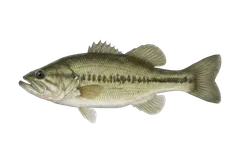 Largemouth bass
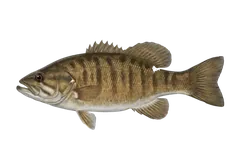 Smallmouth bass
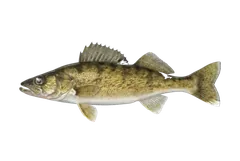 Walleye
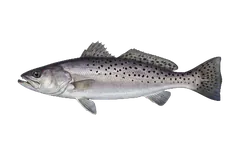 Speckled trout
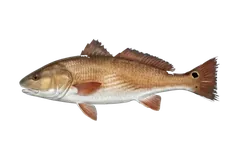 Redfish